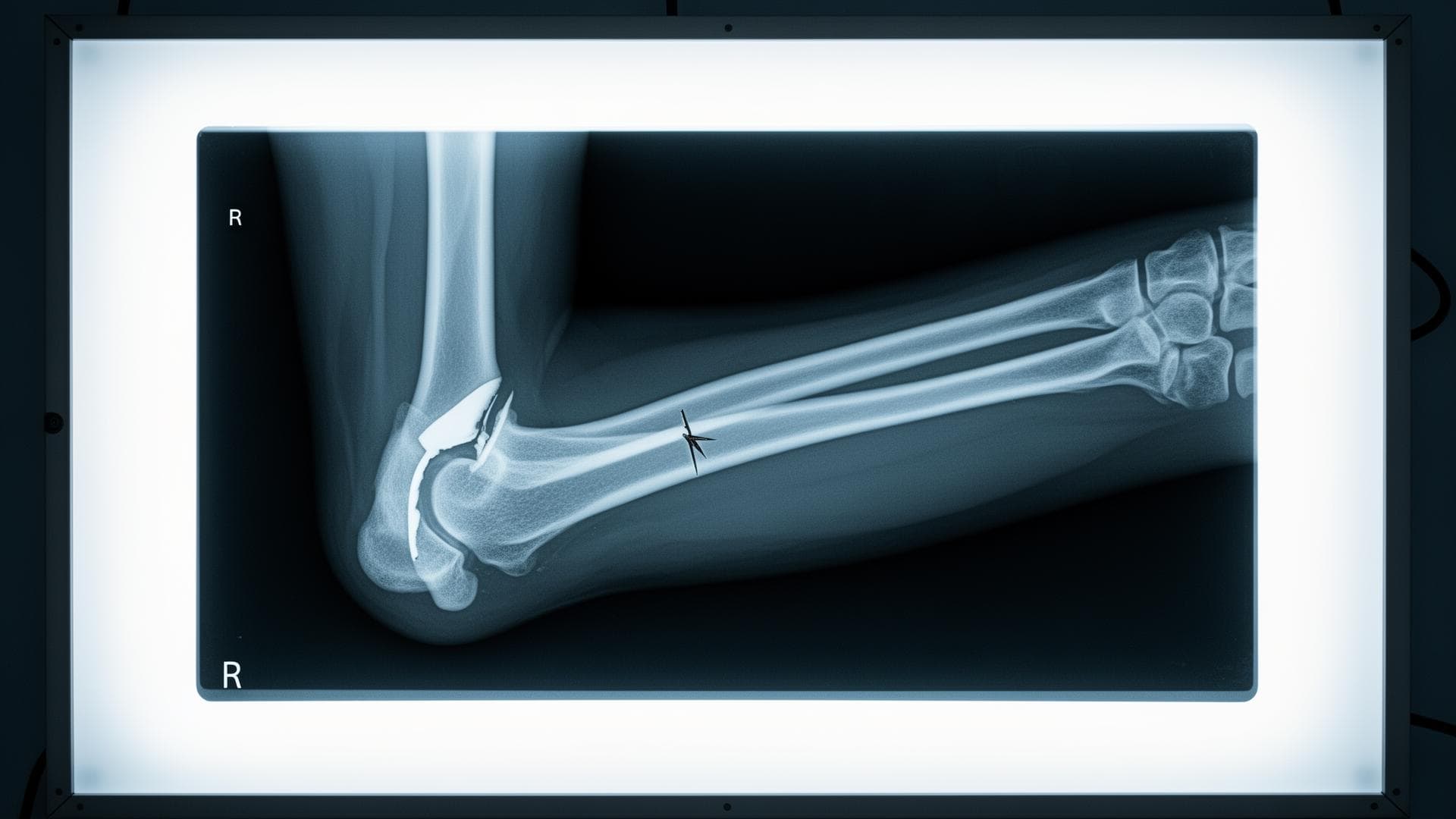
How Common Are Fractures in Car Accidents?
Bone fractures are among the most common serious injuries in motor vehicle accidents. The National Highway Traffic Safety Administration (NHTSA) reports that fractures account for approximately 35% of all injuries requiring hospitalization after a car crash. The forces generated in even a moderate-speed collision — a 30 mph crash generates forces equivalent to falling from a three-story building — routinely exceed the structural limits of human bone.
How Fractures Are Classified (and Why It Matters for Your Case)
Orthopedic fractures are classified by the AO/OTA (Arbeitsgemeinschaft für Osteosynthesefragen / Orthopaedic Trauma Association) system, which grades fractures by bone location, fracture pattern, and severity. Understanding your fracture classification is essential because it directly affects your settlement value: - Simple (closed) fractures: The bone breaks but doesn't penetrate the skin. Generally the least severe, with 6-12 week recovery - Compound (open) fractures: The bone penetrates the skin, creating infection risk and typically requiring emergency surgery. Settlement values increase significantly - Comminuted fractures: The bone shatters into three or more fragments, usually requiring surgical fixation with plates, screws, or rods - Displaced fractures: The bone fragments are misaligned, requiring open reduction (surgical realignment) and internal fixation (ORIF) - Avulsion fractures: A fragment of bone is pulled away by a tendon or ligament attachment - Stress/hairline fractures: Micro-cracks that may not appear on initial X-rays (CT or MRI required for diagnosis)
Settlement Ranges by Fracture Type
While every case is unique and past results do not guarantee similar outcomes, published verdict and settlement data provides general ranges: - Simple wrist/arm fracture (cast treatment): $15,000–$50,000 - Simple leg/ankle fracture (cast treatment): $20,000–$75,000 - ORIF-treated fracture (plates and screws): $50,000–$200,000 - Comminuted fracture requiring multiple surgeries: $100,000–$500,000 - Compound (open) fracture with infection: $150,000–$750,000 - Pelvic fracture (Young-Burgess classification): $100,000–$1,000,000 - Femur fracture (intramedullary nailing): $75,000–$500,000 - Facial fractures (Le Fort, orbital, mandibular): $50,000–$500,000+ - Vertebral fracture (compression or burst): $75,000–$500,000+ - Multiple fractures/polytrauma: $200,000–$2,000,000+
What Drives Fracture Settlement Values?
The key factors that determine how much your broken bone case is worth: - Need for surgery — ORIF (open reduction internal fixation) with hardware dramatically increases case value vs. cast treatment - Permanent hardware — Plates, screws, rods, or joint replacements that remain permanently - Future surgery — Hardware removal, scar revision, or joint replacement increases future medical damages - Permanent impairment — AMA Guides impairment rating quantifies permanent loss of function - Loss of range of motion — Measured by goniometry and compared to contralateral extremity - Arthritis risk — Intra-articular (joint surface) fractures significantly increase future arthritis risk, adding decades of future medical costs - Scarring — Surgical scars and compound fracture wounds create separate disfigurement damages - Impact on employment — Manual laborers with hand/arm fractures face greater economic loss than office workers
The Hardware Factor: Why Surgical Fractures Are Worth More
Insurance adjusters and juries respond differently to fractures treated with surgery versus casts. Surgical treatment — open reduction internal fixation (ORIF) with plates, screws, intramedullary nails, or external fixation devices — produces objective evidence (surgical reports, hardware X-rays) that is impossible to dispute. Post-surgical X-rays showing metal hardware in the bone are among the most powerful exhibits in personal injury litigation.
Future hardware removal surgery is an additional damages component. While not always medically necessary, many patients — particularly younger patients — eventually need hardware removed due to pain, irritation, or interference with adjacent tissue. The cost of hardware removal surgery ($10,000-$30,000) becomes a documented future medical expense in your claim.
Complications That Increase Case Value
Fracture complications can significantly increase settlement values: - Nonunion/malunion — The bone fails to heal properly, requiring additional surgery (bone grafting, revision fixation) - Compartment syndrome — Swelling within a muscle compartment compromises blood flow, requiring emergency fasciotomy - Infection (osteomyelitis) — Bone infection, particularly in open fractures, can require months of IV antibiotics and multiple surgeries - Avascular necrosis (AVN) — Blood supply disruption causes bone tissue death, common in scaphoid (wrist) and femoral neck (hip) fractures - Complex Regional Pain Syndrome (CRPS) — A chronic pain condition that can develop after fractures, producing severe burning pain, swelling, and skin changes - Post-traumatic arthritis — Accelerated joint degeneration following intra-articular fractures
How Bond Legal Maximizes Fracture Case Values
Bond Legal documents every aspect of your fracture injury: operative reports, radiology studies, AMA impairment ratings, functional capacity evaluations, and future medical projections. We work with orthopedic experts to establish the long-term consequences of your fracture — including arthritis risk, future hardware removal, and permanent limitations — ensuring that your settlement accounts for decades of future impact. Contact us at (866) 423-7724 for a free evaluation. Prior results do not guarantee similar outcomes.