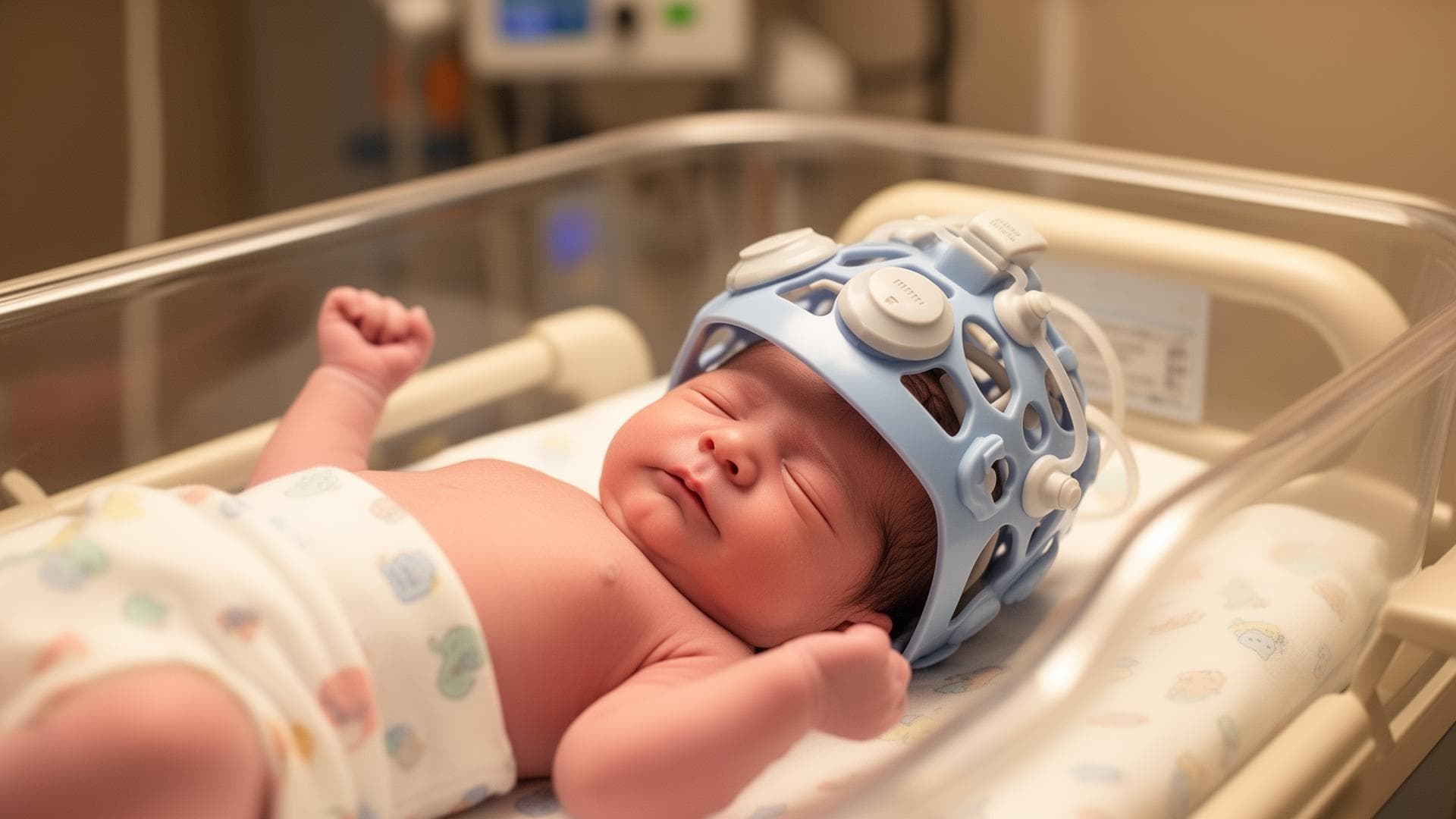
What Is Hypoxic-Ischemic Encephalopathy (HIE)?
Hypoxic-Ischemic Encephalopathy (HIE) is a type of brain damage that occurs when a newborn's brain does not receive adequate oxygen and blood flow (hypoxia-ischemia) during or around the time of birth. HIE affects approximately 1–3 per 1,000 live term births in developed countries, according to data from the National Institute of Child Health and Human Development (NICHD). HIE is classified using the Sarnat staging system: Stage I (Mild) — hyperalertness, normal muscle tone, no seizures. Most infants recover fully. Stage II (Moderate) — lethargy, decreased muscle tone, clinical seizures. Approximately 20–35% of moderate HIE infants develop significant disability without treatment. Stage III (Severe) — coma, flaccid tone, prolonged seizures, brain stem dysfunction. Mortality exceeds 50%, and most survivors have severe neurological impairment.
What Is Therapeutic Hypothermia (Cooling Therapy)?
Therapeutic hypothermia — commonly called 'cooling therapy' or 'brain cooling' — is the standard of care for moderate-to-severe HIE in term and near-term newborns (≥36 weeks gestational age). The treatment involves lowering the baby's core body temperature to 33.5°C (92.3°F) for 72 hours, followed by slow rewarming over 6–12 hours. The therapy works by: slowing the brain's metabolic rate, reducing inflammation and excitotoxicity (the secondary injury cascade), decreasing apoptosis (programmed cell death), and preserving neurons in the 'penumbra' zone — brain tissue that is injured but not yet dead.
What Is the Evidence That Cooling Works?
Therapeutic hypothermia is supported by robust clinical trial evidence. The landmark NICHD Whole-Body Hypothermia Trial (Shankaran et al., *NEJM* 2005) demonstrated that cooling reduced the combined outcome of death or moderate-to-severe disability from 62% to 44% in infants with moderate-to-severe HIE. The CoolCap Trial (Gluckman et al., *Lancet* 2005) and the TOBY Trial (Azzopardi et al., *NEJM* 2009) produced consistent results. A Cochrane systematic review (2013, updated) of 11 randomized controlled trials involving over 1,500 infants confirmed that therapeutic hypothermia significantly reduces mortality and major neurodevelopmental disability in term infants with HIE. Based on this evidence, therapeutic hypothermia has been the standard of care since approximately 2010 for eligible infants.
What Is the 6-Hour Window and Why Is It Critical?
All major clinical trials initiated cooling within 6 hours of birth. This window corresponds to the pathophysiology of HIE: after the initial hypoxic insult, there is a 'latent phase' of approximately 6 hours during which secondary brain injury has not yet fully developed. Initiating cooling during this window can interrupt the secondary injury cascade and preserve brain tissue. After 6 hours, the secondary injury process is well underway, and the therapeutic benefit of cooling diminishes significantly. This means that any delay in recognizing HIE, transferring the infant to a cooling center, or initiating the cooling protocol can result in preventable brain damage.
When Is Failure to Cool Considered Medical Malpractice?
Since therapeutic hypothermia became the standard of care, failure to offer or initiate cooling for eligible infants constitutes a potential breach of the standard of care. Common negligence scenarios include: Failure to recognize HIE criteria — the baby meets cooling criteria (low Apgar scores, acidotic cord gases, clinical encephalopathy, seizures) but the medical team fails to initiate the protocol. Delayed transfer — the delivering hospital lacks a cooling program but fails to arrange emergent transfer to a facility with NICU cooling capability within the 6-hour window. Protocol errors — cooling is initiated but managed incorrectly (wrong target temperature, inadequate monitoring, premature rewarming). Failure to perform qualifying assessments — the hospital does not obtain cord blood gases, perform neurological exam, or order amplitude-integrated EEG (aEEG) to determine cooling eligibility.
What Should Parents Do If They Suspect Their Baby Should Have Been Cooled?
If your baby was diagnosed with HIE and did not receive therapeutic hypothermia — or if cooling was significantly delayed — you should request complete medical records including delivery records, cord blood gas results, Apgar scores, NICU admission notes, and any transfer documentation. An attorney experienced in birth injury cases can have these records reviewed by a neonatologist to determine whether cooling should have been initiated and whether the failure to cool (or delay in cooling) contributed to your child's neurological outcome. Bond Legal handles HIE and cooling therapy cases on a contingency fee basis. Call (866) 423-7724 for a free consultation.